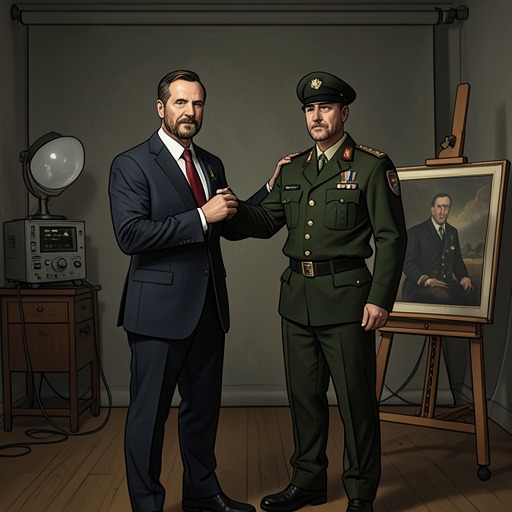
The police-box tryst
My PolicemanThe police-box tryst is the encounter in which Patrick Hazlewood’s patient pursuit of Tom Burgess turns into acknowledged intimacy. Hidden inside Tom’s place of work, the two men move from caution to physical closeness, while Tom’s question about being shared makes clear that desire does not remove the limits surrounding their relationship.
Setting and Approach
Patrick arrives at a small police box on Burlington Street, looking for the man who is both the object of his affection and a serving policeman. The setting’s double character matters: its frosted windows and public position offer concealment, but its function as a police post makes the place inseparable from the rules Tom must observe. Patrick sees no bicycle outside. He understands that its presence would mean a sergeant’s visit, so its absence reassures him that he may find Tom alone.
The encounter follows a period of deliberate restraint. After an earlier meeting, Patrick passed the police box without finding Tom there; even so, he felt buoyant, whistled as he went about his museum work, and told himself that the relationship might grow if he did not rush or frighten Tom away. A distant glimpse of Tom on Burlington Street did not prompt Patrick to run after him. That self-command gives the later visit its force: the tryst is not an accidental meeting but the result of Patrick’s decision to wait, watch, and take a calculated risk when the opportunity appears.
The Encounter
At the door, Patrick begins with an apology. Tom takes a moment to register his arrival, checks that the way is clear, then pulls him inside and shuts the door. His alarm reflects the difference between their positions: Patrick can transgress the rules that govern the space, while Tom believes that he cannot. The police box therefore offers privacy without safety. Their intimacy takes place within an institution whose expectations make discovery consequential for Tom.
Patrick says he has brought a spare set of keys to his flat, offering Tom access even when Patrick is absent. Tom does not take them immediately, and Patrick leaves them on a shelf beside Tom’s flask. The keys are both practical and personal: they extend an invitation beyond the cramped, borrowed privacy of the police box, but their placement also leaves the offer unresolved. Patrick then apologizes again and appears ready to go, yet instead holds the top button of Tom’s jacket. His gradual movement from one button to the next turns a declaration of attraction into a sequence of tentative gestures. Tom does not pull away. He takes Patrick’s fingers, draws them to his lips, and then guides them against his groin.
Negotiating Intimacy
Tom’s question about whether Patrick can share him alters the meaning of the encounter. The scene has established mutual desire, but the question makes clear that desire alone does not settle what kind of relationship they can have. Patrick pauses over the meaning of sharing, then agrees if that is what Tom requires. The agreement is significant less as a general account of their future than as a choice made in this particular moment: Patrick accepts a condition rather than letting the opportunity for closeness end.
The scene moves from Patrick’s planned gesture—the spare keys, his apology, his effort to hold Tom’s attention—to an exchange in which Tom takes the initiative. Patrick’s insistence that he cannot stop thinking about Tom meets Tom’s physical response, and their breathing and actions communicate what neither has yet made secure in words. The encounter ends with Patrick kneeling before Tom. The narrative does not present the police box as a settled domestic refuge; instead, it is a temporary and risky space where the men can act on their attraction while remaining subject to unequal constraints.
Significance
The tryst changes the relationship from Patrick’s hoped-for possibility into a mutual, bodily acknowledged attachment. Earlier, he had imagined friendship and a future in which he could offer Tom something he wanted; here, Tom’s actions answer that hope while his question about sharing introduces a condition Patrick must face. The result is neither simple reassurance nor a promise of exclusivity, but a new intimacy shaped by negotiation.
The scene also links private affection to public vulnerability. Tom’s uniformed occupation is not incidental: it explains his fear of breaking rules and makes the police box a charged setting for a secret encounter. Patrick can imagine the place as an ideal hiding spot, but its official purpose remains present even behind its closed door. That tension anticipates the wider pressures around their relationship without making the tryst itself a resolution. The keys offer another possible space for meeting, while Tom’s delayed response leaves the invitation open rather than converting it into an assured arrangement.